
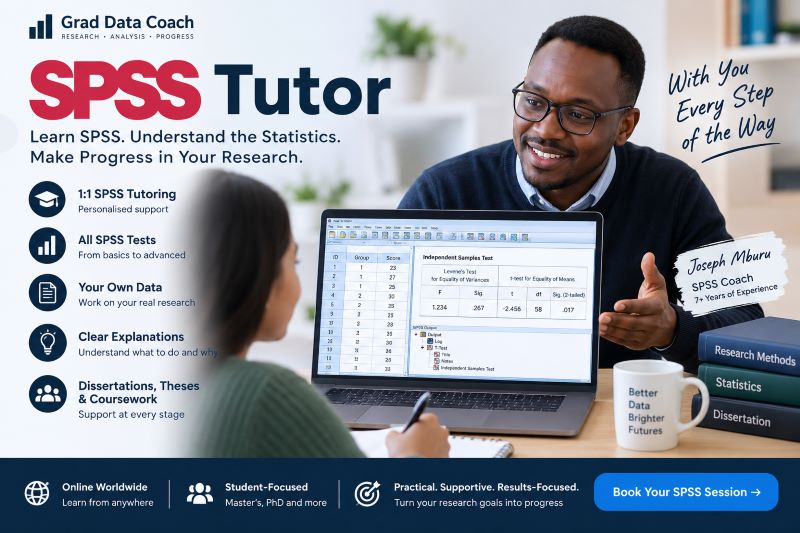
Learn SPSS With a Tutor Who Explains the Statistics Too
SPSS becomes much easier when you understand what you are trying to do before you start clicking through menus. The challenge for many students is that they can follow an online tutorial and still feel unsure about which test fits their research, what options to select, or what the output actually means.
Grad Data Coach offers private 1:1 SPSS tutoring built around your own work. You can bring a coursework problem, dissertation dataset, thesis analysis, SPSS output, or supervisor feedback to your session. We then work through the problem together at a pace that makes sense for you.
You will not only learn where to click in SPSS. We will also discuss why the analysis is appropriate, what the important settings mean, how to check the results, and how to explain your findings clearly.
Book a Private 1:1 SPSS Session
What Do You Need Help With in SPSS?
You do not need to know the exact name of the statistical problem before contacting an SPSS tutor. Many students simply know that they have data, an assignment, or SPSS output and are unsure what to do next.
You may need help because:
- You are new to SPSS. Learn how the interface works and how to set up, manage, and analyze your data.
- You do not know which statistical test to use. Work through your research question, variables, and study design before choosing an analysis.
- Your SPSS output looks confusing. Identify the tables and statistics that actually matter.
- You followed a tutorial but your output looks different. Review your data setup, selected options, and analysis together.
- Your supervisor has questioned your analysis. Bring the comments to your session and work through what needs attention.
- You understand the statistics but not SPSS. Learn how to translate the statistical method into the correct SPSS procedure.
- You can run the test but cannot interpret it. Connect the output back to your research question.
Start with the problem that is slowing you down. We can work from there.
Learn SPSS Using Your Own Data
Generic datasets are useful when you are first learning SPSS. However, the real questions often begin when you open your own research dataset.
Your variables may have different measurement levels. Missing values may appear in unexpected places. Questionnaire items may need reverse coding, and your statistical output may not resemble the example from the tutorial you followed.
That is why our SPSS tutoring sessions can focus directly on your own anonymized data.
For example, we can work through how to:
- Identify your outcome and predictor variables.
- Check whether variables have been coded correctly.
- Add useful variable and value labels.
- Handle missing values.
- Create scale or composite scores.
- Choose an appropriate statistical procedure.
- Run the analysis in SPSS.
- Check assumptions where necessary.
- Interpret the output.
- Decide what the result means for your research question.
Using your own research makes the session practical. You learn SPSS while solving the problem you actually need to solve.
Used AI for Your SPSS Analysis but Still Don’t Understand It?
AI can be useful when you need a quick explanation of a statistical test or a list of SPSS steps. You may even have used AI to choose an analysis, interpret a table, or draft a results statement.
The difficulty comes when you are still unsure why the test was selected or whether the explanation fits your actual research.
Perhaps AI told you to run multiple regression, but you cannot explain why. Maybe it gave you SPSS instructions, yet your output looks different. You may also have a polished interpretation but still feel uncomfortable explaining it to your supervisor.
Bring what you have already done to your live session. We can check the reasoning together, run the analysis where needed, and explain the results in plain language.
You do not have to start again simply because you used AI. The aim is to make sure you understand the analysis yourself.
What Can an SPSS Tutor Teach You?
SPSS covers a wide range of statistical tasks, so the content of your session depends on your current level and research needs.
We can work through areas such as:
- SPSS basics. Understand Data View, Variable View, variable types, value labels, missing values, and the Output Viewer.
- Data entry and preparation. Import data, clean variables, recode values, compute new variables, and prepare a dataset for analysis.
- Descriptive statistics. Calculate means, standard deviations, frequencies, percentages, medians, and other summaries.
- Assumption testing. Review normality, outliers, homogeneity of variance, residuals, and other relevant checks.
- Hypothesis testing. Run common statistical tests and understand when each one is appropriate.
- Output interpretation. Learn how to find the values you actually need instead of trying to understand every SPSS table.
- Results reporting. Turn the output into a clear results section without simply copying the software tables.
- Troubleshooting. Work through unexpected values, error messages, unusual results, or analysis settings.
You can focus the entire session on one problem or work through several connected SPSS tasks.
SPSS Statistical Tests We Can Work Through
You do not need to learn every statistical method in SPSS. Your session can focus on the analyses that matter for your course or research.
These may include:
- Descriptive statistics. Means, standard deviations, frequencies, percentages, medians, and data summaries.
- One-sample t test. Compare one sample mean with a known or hypothesized value.
- Independent samples t test. Compare the mean outcome between two separate groups.
- Paired samples t test. Compare two related measurements or repeated observations.
- ANOVA. Compare means across three or more groups.
- ANCOVA. Compare groups while accounting for relevant covariates.
- Correlation. Examine relationships between numerical variables.
- Multiple regression. Examine how several predictors relate to an outcome.
- Logistic regression. Model categorical outcomes.
- Chi-square tests. Examine associations between categorical variables.
- Nonparametric tests. Use suitable alternatives when the research question and data require them.
- Reliability analysis. Work through Cronbach’s alpha and item-level information.
- Factor analysis. Explore factor structure and interpret relevant output.
The analysis should always follow your research question rather than the software menu.
Learn How to Interpret SPSS Output
Running a statistical test is often much easier than interpreting the output.
SPSS may give you several tables with values such as F, t, p, R², confidence intervals, coefficients, effect sizes, and assumption tests. A beginner can easily focus on the wrong table or assume that every number needs to appear in the final report.
During tutoring, we work through the output in a logical order. First, we identify what each table is trying to tell you. Next, we find the values that answer your research question. Finally, we connect those values to an interpretation you can explain in your own words.
For example, if you run an independent samples t test, we would not stop at p < .05. We would also examine the group means, standard deviations, mean difference, confidence interval, and effect size where appropriate.
If you want to see how this process works, read our step-by-step guide on how to run an independent samples t test in SPSS.
Learn SPSS From the Beginning
You do not need previous SPSS experience before booking a tutoring session.
If you are starting from scratch, we can begin with the basics and build gradually. For example, your first session might cover how SPSS stores data, how rows and columns work, and how to distinguish numeric values from category codes.
From there, we can move into:
- Creating variables.
- Adding labels.
- Entering or importing data.
- Checking for missing values.
- Producing frequency tables.
- Calculating descriptive statistics.
- Creating simple charts.
- Saving output.
- Understanding the difference between data and statistical results.
The aim is to make each new step connect to something you already understand. You do not need to memorize the entire SPSS interface.
Once the basics make sense, running statistical analyses becomes much easier because you understand what the software expects from your data.
SPSS Tutoring for Dissertation and Thesis Research
SPSS often becomes more challenging during a dissertation or thesis because you are no longer working with a clean classroom example. The analysis has to match your own research questions, variables, sample, and methodology.
A tutoring session can help you work through:
- Preparing your dissertation dataset.
- Matching research questions with statistical tests.
- Creating questionnaire scale scores.
- Checking reliability.
- Running descriptive statistics.
- Checking statistical assumptions.
- Performing hypothesis tests.
- Interpreting SPSS tables.
- Responding to supervisor comments.
- Understanding what belongs in your results section.
- Preparing to explain your analytical decisions.
If you need broader support across several stages of your study, our dissertation data analysis help service may be a better fit.
The coaching approach remains the same. We work through the analysis together so you understand the decisions involved.
SPSS Tutoring for Master’s Students
A Master’s dissertation may be the first time you have had to choose and perform statistical analyses independently. You may have learned individual tests in class but still feel uncertain about how they fit together in a real research project.
SPSS tutoring can help bridge that gap.
For example, we can start with your research questions and determine what needs to be analyzed. We can then prepare the data, choose suitable procedures, run them in SPSS, and work through the output together.
The session can also focus on one specific area if most of your analysis is already complete. You might only need help with regression, reliability, assumption testing, or interpretation.
If you need support beyond SPSS itself, visit our dedicated data analysis help for Master’s students page.
SPSS Tutoring for PhD Students
At PhD level, you may need more than instructions for running a test. Your supervisor or examiners may expect you to justify why you selected the method, discuss assumptions, interpret the output carefully, and acknowledge the limits of your conclusions.
Private SPSS tutoring can focus on those deeper questions.
Bring your research questions, dataset, existing analysis, or supervisor comments to the session. We can review how the statistical method fits your study and then work through the SPSS procedure and interpretation.
Advanced projects may involve regression, mediation, moderation, factor analysis, or other methods. The important point is not to make the analysis complicated simply because the research is doctoral. The method still needs to fit the question and data.
Doctoral researchers can learn more about our dedicated PhD data analysis help service.
Meet Joseph, Your SPSS Tutor
When you book an SPSS tutoring session with Grad Data Coach, you can work directly with Joseph Mburu.
Joseph holds a Bachelor’s degree in Applied Statistics with Computing and a Master’s degree in Data Science and Analytics. He has more than seven years of experience coaching Master’s and PhD students through statistics, SPSS, research methods, dissertations, theses, and data analysis problems.
His approach combines two things that matter when learning SPSS: understanding the software and understanding the statistics behind it.
Instead of only saying, “Click Analyze, then select this option,” Joseph explains why the procedure fits the research question, what the important settings do, and how to interpret the resulting output.
The goal is to make statistics easier to follow without oversimplifying the decisions involved.
You can learn more about Joseph and Grad Data Coach before booking.
How Does a 1:1 SPSS Tutoring Session Work?
The session starts with what you need to learn or solve. You do not need to prepare a formal lesson plan.
The process is simple:
- Tell me where you are stuck. Explain the assignment, statistical test, dissertation problem, or SPSS output you want to understand.
- Share the relevant material. This may include your anonymized dataset, research questions, SPSS output, assignment instructions, or supervisor comments.
- Work through it together. We use your actual problem as the basis of the session.
- Ask questions as we go. Stop whenever a menu option, statistic, or interpretation does not make sense.
- Practice the process. Where useful, you can repeat the steps so you know how to perform the analysis yourself.
- Leave with a clear next step. Understand what you need to do after the session and why.
One focused session may be enough for a particular test. Larger dissertations may benefit from several sessions at different stages.
What Should You Bring to Your SPSS Session?
You do not need to send everything related to your course or dissertation. Bring the material that helps explain the problem.
Useful items may include:
- Your research question or assignment question.
- An anonymized SPSS
.savfile. - A CSV or Excel dataset.
- SPSS output.
- Your questionnaire or measurement instrument.
- Variable descriptions or a codebook.
- The statistical test you have been asked to perform.
- Supervisor or instructor feedback.
- A section of your methodology.
- Your current interpretation.
- AI-generated steps or explanations that you want to check.
Remove unnecessary identifying information before sharing research data. Names, email addresses, telephone numbers, addresses, patient identifiers, student numbers, and similar information should normally be removed.
If you are unsure what to bring, simply explain the problem when booking.
Free SPSS Guides You Can Use Before Your Session
You may be able to solve a straightforward SPSS problem using one of our free guides before you book tutoring.
Start with:
- How to Run Descriptive Statistics in SPSS if you need means, standard deviations, frequencies, percentages, or basic data summaries.
- How to Run a One-Sample t Test in SPSS if you want to compare one sample mean with a benchmark or hypothesized value.
- How to Run an Independent Samples t Test in SPSS if you want to compare a numerical outcome between two separate groups.
These guides explain the general process using simple examples.
If your own research is more complicated, you can then bring the exact point where you became stuck to your tutoring session rather than starting from the beginning.
Why Work With a Human SPSS Tutor?
Online tutorials, courses, forums, and AI tools are useful because they make statistical information available immediately. The problem is that they cannot always see the full context of your research or tell whether you have misunderstood an important decision.
A live tutor gives you something different.
- Ask follow-up questions. You do not have to accept an explanation that still does not make sense.
- Use your own dataset. Work through the variables and output that matter for your research.
- Explain your reasoning. Check whether you actually understand why the method fits.
- Catch mistakes early. Identify coding, setup, or interpretation problems before they spread through the analysis.
- Learn at your pace. Spend more time on difficult concepts and move quickly through what you already understand.
- Prepare to explain your work. Become more confident when discussing the analysis with a supervisor, lecturer, or examiner.
The goal is not to replace useful technology. It is to help you use it with understanding.
Online SPSS Tutor for Students Worldwide
Grad Data Coach provides SPSS tutoring online, so you can work with Joseph regardless of where you study.
Students and researchers can book sessions from the United States, United Kingdom, Australia, Canada, Europe, Africa, Asia, the Middle East, and other regions worldwide.
Online tutoring also works well for SPSS because the session can focus directly on the software, your dataset, and your output. Instead of explaining what you see on your screen through a long email exchange, we can work through the statistical problem together during the session.
You can book help for a single test, an assignment, a dissertation analysis, or a specific SPSS concept that you want to understand better.
Current session options are available on our pricing page.
SPSS Tutoring and Academic Integrity
Grad Data Coach provides teaching, coaching, and statistical guidance.
The purpose of SPSS tutoring is to help you understand the analysis and perform your own academic work. You remain responsible for anything that you submit to your university.
During a session, we can explain statistical concepts, demonstrate SPSS procedures, work through your data with you, review output, and help you understand supervisor feedback. However, the aim is not to give you unexplained results that you cannot defend.
Universities also have different rules on external tutoring, statistical support, and AI use. Follow the requirements of your institution and disclose outside assistance where required.
A good tutoring session should leave you more capable of working independently, not more dependent on someone else to interpret every SPSS table for you.
Frequently Asked Questions
Yes. We can start with the basics, including Data View, Variable View, coding, value labels, descriptive statistics, and output. From there, we can move into the statistical procedures required for your course or research.
Yes. Working with your own anonymized data often makes the session more useful because you learn SPSS while solving the problem you actually need to solve.
Yes. We can review your research question, variables, study design, and data before deciding which procedure makes sense. You do not need to know the correct test before booking.
Yes. Bring the output to your session. We can identify the relevant tables and statistics and work through what they mean for your research.
Yes. We can review the proposed test, SPSS steps, output, or interpretation together. The aim is to help you understand whether the approach makes sense and how to perform or explain it yourself.
No. SPSS tutoring focuses on learning and understanding. We work through the analysis together so that you know how the procedure works and what the results mean.
Ready to Understand SPSS Instead of Just Clicking Through It?
You do not need to memorize every SPSS menu or become a statistician before you can analyze your research correctly.
Bring the problem that is currently confusing you. It may be a dataset you do not know how to clean, a statistical test you cannot run, a table you cannot interpret, or an AI-generated explanation that still does not make sense.
During your private session, you can work directly with Joseph and ask questions as you go. The goal is for you to leave knowing what you did, why you did it, and what the SPSS results mean.